The Complete Guide to TV Screen Repair in Gauteng
A modern television screen is a remarkably complex piece of engineering — an LCD, QLED or OLED panel made up of millions of independently-addressed sub-pixels, all driven by a network of timing controllers, source drivers, gate drivers, ribbon cables and voltage regulators that have to operate in perfect synchronisation. When any one of those parts misbehaves, the symptom appears on your screen as lines, bars, dark zones, flicker or no picture at all. The good news for Gauteng households is that the vast majority of "screen problems" are caused by replaceable supporting electronics — not by the panel glass itself. That distinction is the difference between a R1,100 repair and writing off the TV entirely.
At Nathtec TV Repairs we've spent more than a decade diagnosing exactly those faults for households and businesses across Johannesburg, Sandton, Pretoria, Midrand, Randburg and Soweto. Our screen-repair process has been refined into a four-step assessment that consistently identifies the actual root cause within the first hour of bench time. The result for you is faster turnaround, lower repair bills and the confidence that you're paying for the fix that's genuinely needed rather than the most profitable one for the shop.
How a Modern TV Screen Is Actually Built
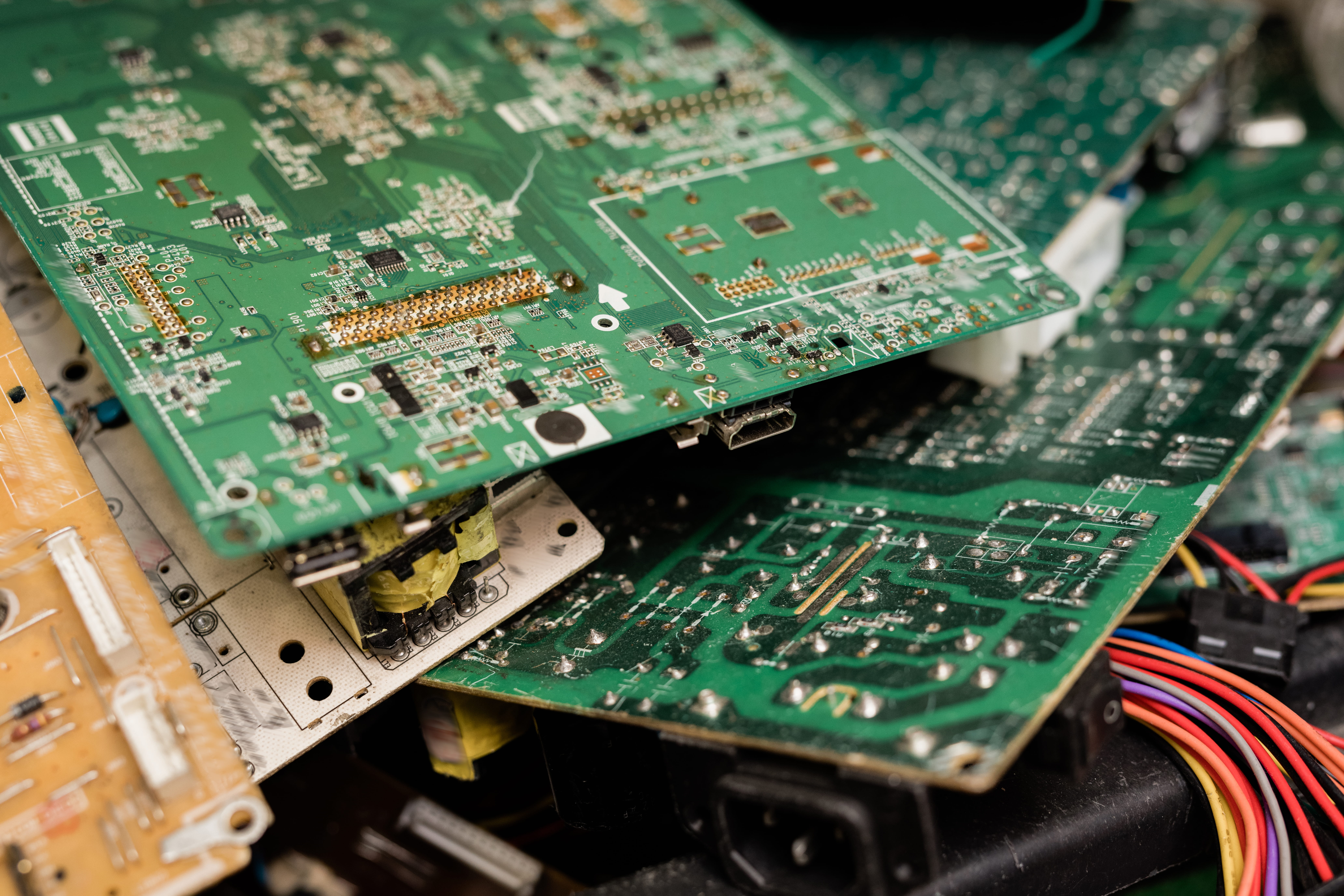
Understanding what's behind the glass helps make sense of every screen fault you might see. The visible front surface is a polariser layer over the LCD or OLED matrix. Behind the matrix sits the row of source drivers (left/right) and gate drivers (top/bottom), implemented as chip-on-film (COF) units bonded directly to the panel edges. These are fed by a T-Con board — the timing controller that converts the video signal into row and column addressing — typically located behind the panel and connected via flexible LVDS ribbon cables. On LCD and LED-LCD TVs there's a backlight assembly behind the panel (edge-lit strips or full-array LED zones). On OLED TVs there is no backlight; every pixel produces its own light.
Every fault visible on your screen maps to one of those subsystems. Vertical lines from top to bottom of the picture point to a source driver or T-Con issue. Horizontal lines or bars across the width of the picture point to a gate driver or T-Con timing fault. A completely dark screen with sound still working is almost always a backlight failure on LCD/LED models, or a power-feed issue to the panel on OLED. A clearly cracked or impact-damaged area is the only fault category that genuinely requires a panel replacement.
Why "Lines on the Screen" Doesn't Usually Mean a New TV
It's an extremely common scenario: a customer walks into the workshop with a Samsung, LG, Hisense or TCL television showing three or four pink, green or white vertical lines down the screen, having already been told by another shop that the panel is finished and the TV is "uneconomical to repair". In our experience, in well over 80% of these cases the panel is perfectly fine. The lines are coming from a marginal capacitor on the T-Con, an oxidised contact on one of the LVDS ribbon cables, or a single failed source driver IC — every one of which is repairable for between R1,100 and R2,900.
The reason cheap repair shops default to "replace the panel" is simple: it's the easiest diagnosis to make (no real testing required) and it's the most lucrative for them when the customer ends up buying a new TV. At Nathtec we've built our reputation on the opposite approach. Every screen fault is properly tested with our pattern generators and oscilloscope before we recommend anything. If we can save you eighteen thousand Rand by replacing a R280 driver IC, we will — and our 90-day warranty backs it up.
Half-Screen Failure, Banding and Flickering
Half-screen failure (where one side of the picture goes black, washed-out or shows a single solid colour) is one of the most distinctive screen faults we see. The root cause is nearly always on the affected half of the panel: either a failed source-driver IC inside the chip-on-film assembly, a broken or detached ribbon cable feeding that side, or in rarer cases a failed half of the T-Con board itself. Around 60% of half-screen faults can be repaired through ribbon reseating, T-Con component repair or COF rebonding for between R1,450 and R2,900. The remaining 40% are panel-level damage that we'll honestly identify and advise on.
Banding (visible horizontal or vertical bands across the picture, especially in solid colours or during fades) usually points to T-Con timing issues or marginal voltage rails feeding the panel. Flickering, especially the rapid kind that gets worse with brighter content, is more often a backlight LED driver fault than a screen fault per se — see our dedicated backlight repairs page for the full diagnosis path. Both faults are highly repairable and we resolve them every week.
Cracked Screens — The Honest Conversation
If your television has suffered a physical impact and now shows a visible crack with a spreading dark "ink-blot" pattern, we owe you a straightforward answer rather than false hope: that panel is unrepairable. The crack has destroyed the liquid crystal alignment layer at the molecular level, and no patching, gluing, polish or screen film can restore it. The only remedy is to fit a replacement panel — and on every TV smaller than about 55 inches, that panel costs significantly more than a brand-new replacement television. We won't waste your time and money quoting a repair that doesn't make economic sense.
What we can do in cracked-panel cases is give you a no-charge written assessment confirming the diagnosis (useful for insurance claims), and salvage the working main-board, power-supply, speakers and stand from the damaged TV for future repair stock if you'd like to donate them. For 65-inch and larger premium QLED or OLED units where panel replacement might just be viable, we'll quote both options transparently so you can make an informed decision.
T-Con Boards and Ribbon Cables — The Hidden Heroes
The T-Con (timing controller) board is the single most-overlooked component in a modern TV, and also the single most common culprit when something goes wrong with the screen. It sits behind the panel, takes in the LVDS video signal from the main board, and translates it into the precisely-timed row and column addressing that lights up each pixel. T-Cons fail in characteristic ways: a single bad capacitor causes lines or flicker; a failed voltage regulator causes a completely blank panel with sound still working; a corrupted EEPROM (rare) causes garbled output that looks like complete panel failure.
The good news is that T-Con boards are eminently repairable. Our workshop holds the most common Samsung, LG, Hisense, TCL and Sony T-Con boards in stock, and where the exact board isn't on the shelf we can usually component-repair the original. Ribbon cables (the flexible printed flat cables that carry the LVDS signal from the T-Con to the panel) are the second most common screen-fault root cause — they oxidise at the contact pads over years of South African humidity, and a simple clean-and-reseat solves more screen complaints than anyone expects.
Brand-Specific Screen Issues We Resolve
Different TV brands fail in characteristically different ways at the screen level. Samsung QLED panels typically suffer from T-Con capacitor failure (vertical lines) and uneven local-dimming halos on full-array models — both very repairable. LG OLED screens occasionally develop the well-known "vertical green line" issue on 2016–2019 models, which is a T-Con timing fault rather than a true panel fault, and we resolve it routinely. Sony Bravia panels are typically very robust; when they do fail it's usually at the X1 video processor or T-Con rather than the panel itself. Hisense, TCL and Skyworth models share certain T-Con board families and tend to develop similar capacitor failures around the 3-to-5-year mark.
Whatever brand you have, our component library and parts network covers it. We work on Samsung, LG, Sony, Hisense, TCL, Skyworth and Panasonic screens every week, and the experience translates into faster diagnosis and lower repair costs for you. For a complete view of repair pricing across all screen and TV faults, see our repair cost guide or our overview of common TV problems.
Same-Day TV Screen Repair Across Gauteng
For the majority of common screen faults — T-Con repair, ribbon reseat, half-screen driver work — same-day turnaround is genuinely achievable provided the TV reaches our workshop in the morning. Larger panels, complex COF rebonding work or component-level T-Con repair on rare boards may extend to 48 hours. Cracked-panel assessments are always free of charge and turned around within 24 hours. For in-home assessment of larger sets, we cover Johannesburg, Sandton, Pretoria, Midrand, Randburg and Soweto, with collection and delivery available at workshop-friendly rates.
For related TV faults, see our pages on Smart TV repairs, motherboard repairs, HDMI port repairs, backlight repairs, power supply repairs, and our installation services including wall mounting and TV installation. To start a screen-repair conversation, call or WhatsApp us on 078 721 3551 with the TV brand, size and a quick photo or video of the screen fault. We respond within minutes during business hours.