The Complete Guide to TV Motherboard Repair in Gauteng
If you have searched for TV motherboard repair near me, TV main board replacement Gauteng or TV stuck on logo fix, this guide explains exactly what you are dealing with and how a professional component-level repair shop approaches the work. The information here is the result of more than a decade of continuous TV repair across Johannesburg, Pretoria, Sandton, Midrand, Randburg and Soweto, and is written specifically for South African homeowners trying to make a sensible decision about a broken television.
What the TV Main Board Actually Does
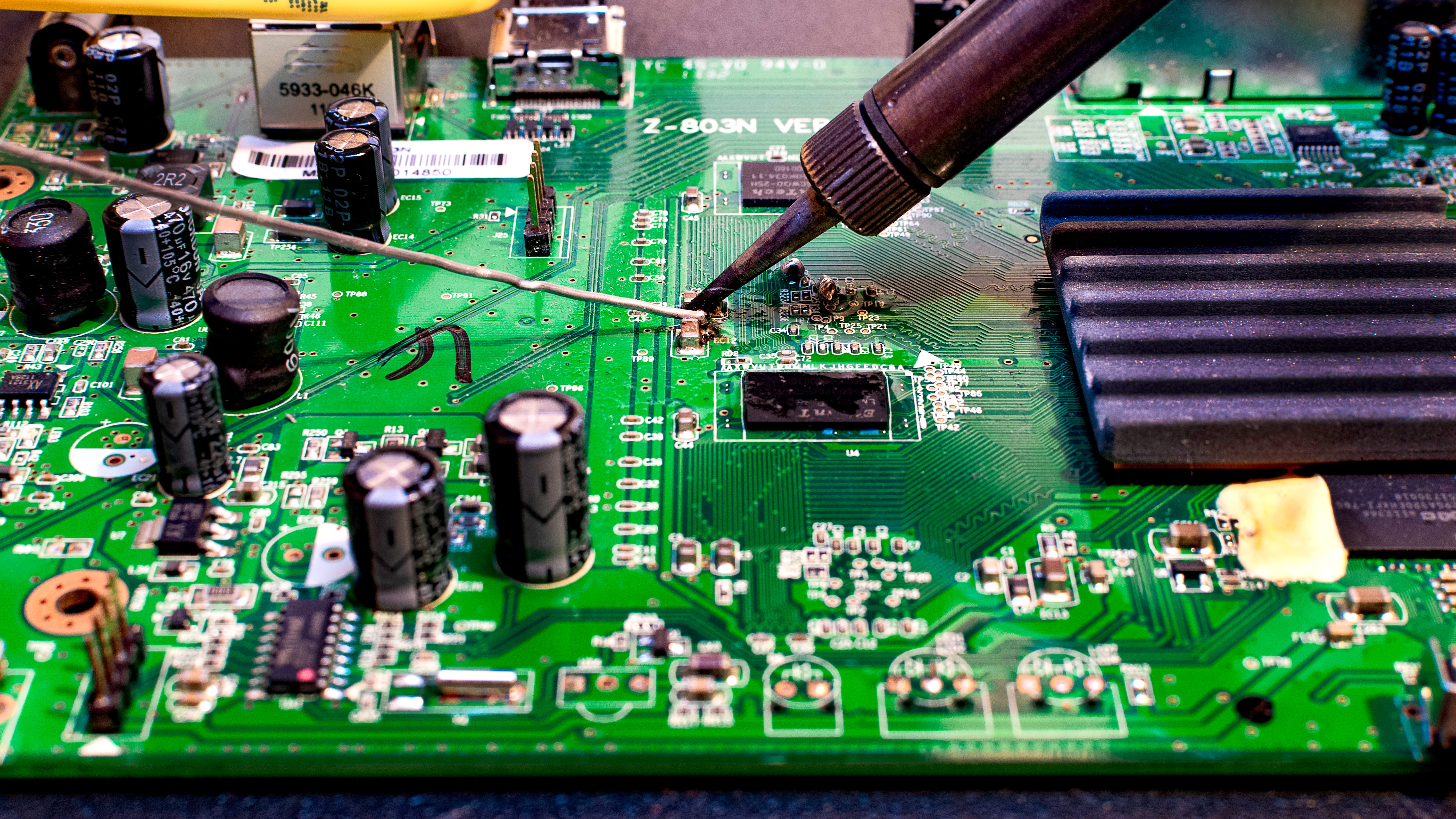
Every modern television contains three principal circuit boards: the power-supply board (PSU), the timing-controller board (T-Con), and the main board - sometimes called the digital board, the system board, the mainboard or simply the motherboard. The main board is the most complex of the three. It hosts the SoC (system-on-chip) that runs the smart-TV operating system (Samsung Tizen, LG webOS, Sony's Android TV, Hisense VIDAA, TCL Google TV), the EEPROM and eMMC flash memory that store the firmware and your settings, the TV tuner, the HDMI receiver ICs, the audio DSP, the Wi-Fi and Bluetooth modules, the LVDS or V-by-One panel-interface chips, and dozens of supporting components.
When something on the main board fails, the symptoms can be dramatic - a TV that won't boot, missing inputs, sound with no picture, settings that refuse to save - but the underlying cause is often a single, small surface-mount component that costs less than R20 to replace. The difficulty is not the part; the difficulty is finding which part has failed without damaging anything else in the process. That is the skill that separates a real board-level technician from a board-swap operator.
The Most Common TV Motherboard Faults We See in Gauteng
Across thousands of motherboard repairs in our Gauteng workshop, a small number of fault patterns account for the vast majority of cases. Electrolytic capacitor degradation on the regulated voltage rails near the SoC is by far the most common - the capacitors slowly lose capacitance over 5-8 years, eventually causing intermittent restarts that get more frequent until the TV won't stay on at all. Replacement with low-ESR polymer equivalents fixes the problem permanently and typically costs R900-R1,700.
HDMI receiver IC failure is the second most common - usually after a household lightning event or surge through a connected source device. The classic symptom is all HDMI inputs going dead simultaneously while the TV's own apps work perfectly. Hot-air rework with a genuine OEM replacement IC, typically R1,450-R2,650, restores full functionality. EEPROM and firmware corruption is the third common cause, almost always tied to load-shedding interrupting a firmware update. Service-mode re-flash with the original manufacturer binary takes 60-90 minutes and costs R780-R1,450.
Less common but more serious faults include SoC pad lifting after extreme thermal cycling, LVDS driver failure presenting as lines on the panel or half-screen blackness, and tuner module failure (now less critical because most South African households rely on HDMI sources rather than the integrated tuner). Each of these is repairable but on different cost-benefit profiles - we explain the options clearly in your written quote.
Load-Shedding, Surges and the South African Reality
It is impossible to talk honestly about TV motherboard failures in Gauteng without talking about load-shedding. The repeated power cycling that South African households have endured for the past decade has fundamentally changed the failure profile of consumer electronics. Capacitors that would have lasted 12 years in stable-mains markets are failing at 5-6 years here. EEPROMs that would have died of natural causes are being corrupted by interrupted updates. HDMI receiver ICs are being killed by surges through unprotected source equipment.
Our component-level repair work is, in a real sense, an answer to load-shedding. Every TV we restore to working condition is one that does not go to landfill or back to the importer for an over-priced board swap. We strongly recommend pairing any new or repaired TV with a quality surge-protected power strip - a R420-R720 investment that pays for itself the first time it absorbs a transient. Built-in TV surge protection is minimal; external protection is essential in the current South African grid environment.
Same-Day Motherboard Repair Across Gauteng
The geographic spread of our work covers the whole of Gauteng. We perform main-board repair for customers in Johannesburg, Sandton, Pretoria, Midrand, Randburg and Soweto every working day. For Sandton apartments, Midrand townhouse complexes, Pretoria East family homes and Soweto living rooms alike, we offer in-home diagnostics where the symptom can be confirmed without bench equipment, and workshop collection where the repair requires the full set of board-level tools. Most workshop turnarounds are 24-48 hours.
We work on every model and every brand. For brand-specific deep-dives see our pages on Samsung TV repair, LG TV repair, Sony TV repair, Hisense TV repair, TCL TV repair, Skyworth TV repair and Panasonic TV repair. For related services see our power supply repair, backlight repair, HDMI port repair and smart TV repair pages. For pricing across all service types see our TV repair cost guide, and for a full symptom directory see common TV problems.
How to Book a Motherboard Repair With Nathtec
The fastest way to start is to send us the TV's model number (printed on the rear sticker), the screen size and a short description of what the TV does when you press the power button. WhatsApp 078 721 3551 with that information and we typically respond within minutes during business hours with a likely cause and a realistic price range. From there we can either collect the TV from your address in Gauteng, arrange in-home diagnosis for non-bench-bound faults, or book a workshop drop-off slot. Either way, you get a free written quote before we touch a soldering iron.