Servicing All of Gauteng, South Africa

TV Sound & Audio Repairs in Gauteng — No Sound, Distortion & HDMI-ARC

From a Samsung that suddenly went silent to a Hisense soundbar that refuses to pair, we fix every kind of TV audio fault. Component-level amplifier repair, OEM speaker replacement and full HDMI-ARC / eARC diagnostics across Gauteng.

2,400+
Audio Repairs
94%
Same-Day Fix
90
Day Warranty
★ 4.9
Customer Rating
TV Audio Faults Explained

Why TV Sound Goes Wrong — And What We Can Actually Fix

A television without sound is, in many ways, more frustrating than one without picture. The picture's still there, the remote works, the apps load — but the whole thing has gone silent, or the audio is so distorted it's unwatchable. The good news is that almost every TV sound fault we see in our Gauteng workshop is highly repairable, often for less than R1,800, and most are resolved within a single day on the bench.

The audio chain in a modern TV is genuinely complex: signal enters via HDMI, USB, optical, antenna or via the Wi-Fi/Bluetooth stack from a streaming app; gets decoded by a dedicated audio DSP; flows through a Class-D amplifier IC; and then drives the internal speakers (or is routed out via HDMI-ARC/eARC to an external soundbar or AV receiver). A fault at any one of those points presents as different audible symptoms — and an experienced technician can usually pinpoint the failing stage just from a careful description of what you're hearing.

Symptom Checker

What Your TV Is Doing → What's Probably Wrong

Match your symptom to the most likely cause. Use it as a starting point — full diagnosis confirms the actual fault.

Total silence, picture fine

Symptom: Picture and apps work, mute is off, volume bar moves but zero sound.

Likely cause: Failed Class-D amplifier IC or stuck audio mute in firmware.

Crackling / distorted audio

Symptom: Sound is there but harsh, fuzzy, popping or buzzing — especially at higher volumes.

Likely cause: Partially blown speaker cone or marginal capacitor on the amplifier output.

Sound on one side only

Symptom: Audio plays clearly on the left or right speaker only.

Likely cause: Blown speaker on the silent side, or one channel of the amplifier IC failed.

Sound cuts in and out

Symptom: Audio drops for a second or two intermittently then returns.

Likely cause: Thermal-related amplifier IC fault or loose speaker connector.

Soundbar not getting sound

Symptom: Internal speakers work but ARC/optical soundbar is silent.

Likely cause: HDMI-ARC handshake fault, CEC misconfiguration or faulty ARC port.

Bluetooth won't pair

Symptom: TV doesn't find or refuses to pair with Bluetooth headphones / soundbar.

Likely cause: Corrupt Bluetooth stack in firmware or failed Wi-Fi/BT combo module.

Voice out of sync with picture

Symptom: Lip sync lag — voice arrives clearly before or after the mouth moves.

Likely cause: AV sync setting in firmware or ARC processing delay through soundbar.

Buzzing / humming with no input

Symptom: Low buzzing from the TV even with no source playing.

Likely cause: Power-supply leakage into audio ground or failing amp output coupling cap.

Sound Repair Pricing

Three Common Pricing Tiers

Most TV sound faults fall cleanly into one of these three repair categories.

MOST COMMON

Tier 1 — Speaker Swap

R780 – R1,450

Single or dual OEM speaker replacement. Brand-matched, same-day on most models.

  • ★ Blown speaker cone
  • ★ Crackle on one side
  • ★ Total speaker silence
  • ★ 90-day warranty
RECOMMENDED

Tier 2 — Amplifier IC Repair

R1,100 – R2,200

Component-level Class-D amplifier IC replacement plus surrounding caps and protection components.

  • ★ No sound, speakers OK
  • ★ Distortion at higher volume
  • ★ Thermal cut-out faults
  • ★ 90-day warranty
SEVERE FAULTS

Tier 3 — Full Audio Board

R1,700 – R3,400

Complete audio board replacement when component-level repair is uneconomical. OEM parts only.

  • ★ Lightning-damaged audio
  • ★ Multiple stage failure
  • ★ HDMI-ARC + sound dead
  • ★ 90-day warranty

Please note that all prices displayed are estimated starting prices only. Final repair costs may vary depending on the TV size, model, fault diagnosis, parts required, labour, and any additional repairs needed after inspection. Additional R780–R1,100 for HDMI-ARC firmware re-flash where applicable.

Advanced Audio We Handle

HDMI-ARC, eARC and Dolby Atmos — Done Right

Most TV "no sound" complaints from soundbar owners aren't broken speakers — they're handshake faults.

HDMI-ARC Handshake

CEC negotiation, ARC enable in service mode, port verification and full firmware re-flash for stubborn soundbar handshake faults.

eARC High-Bandwidth

Enhanced ARC for full Atmos passthrough on HDMI 2.1. Diagnostic on the eARC port itself when handshake fails repeatedly.

Dolby Atmos Routing

Atmos passthrough configuration on Samsung, LG, Sony, Hisense and TCL — including bit-stream vs PCM mode forcing.

Bluetooth Pairing

Combined Wi-Fi/Bluetooth module diagnostics, stack re-flash and replacement when the radio itself has failed.

Optical / SPDIF Output

TOSLINK output diagnostics, optical port cleaning and replacement on TVs where ARC has failed permanently.

Lip Sync Tuning

AV-sync offset configuration and ARC delay compensation when voice and picture drift apart.

Recent Sound Repairs

Three Real Audio Repairs From Our Workshop

Case 01 — Randburg

Samsung 55" QLED Total Silence

Symptom: Volume bar moved but absolutely no sound from internal speakers. Soundbar via HDMI-ARC also silent.

Diagnosis: Class-D amplifier IC failed completely — confirmed by signal trace on the audio bus.

Outcome: Amp IC replaced, surrounding caps refreshed. R1,250. Same-day return.

Case 02 — Pretoria East

LG 65" OLED Soundbar Won't Connect

Symptom: Internal speakers worked perfectly. LG soundbar connected via HDMI 2 (eARC) showed no input.

Diagnosis: ARC handshake failure after a webOS update — Simplink had been silently disabled.

Outcome: Firmware reconfigured, eARC re-enabled in service mode. R780. In-home fix.

Case 03 — Sandton CBD

Hisense 50" Crackling Distortion

Symptom: Sound was present but harsh and crackling, especially in dialogue.

Diagnosis: Right speaker cone partially torn after a lightning event during load-shedding.

Outcome: Both speakers replaced with brand-matched OEM units. R980. 24-hour turnaround.

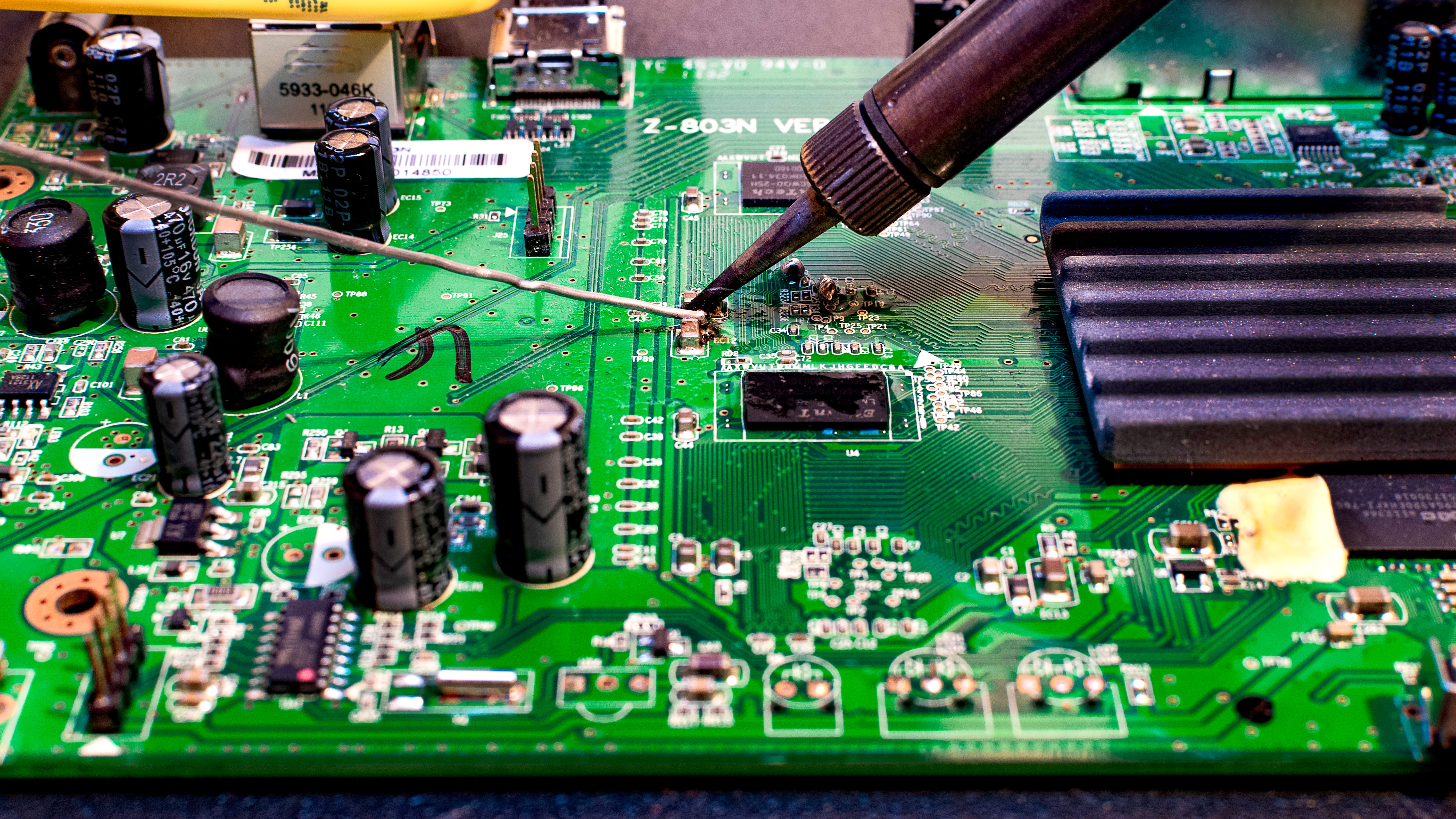
Nathtec technician performing component-level audio amplifier IC repair Audio Specialists
Why Trust Nathtec With Your TV Audio

Component-Level Audio Repair — Not Just Board Swaps

Most repair shops in Gauteng will diagnose a TV no-sound fault by swapping the entire audio board or main board, marking up the part heavily, and sending the customer on their way. We work differently. Our audio repair bench is built around component-level diagnosis: signal injection through the audio bus, oscilloscope tracing of the Class-D amplifier output, ESR checking of the output coupling capacitors, and individual replacement of the actual failed part.

The reason matters. Component-level repair typically costs you 40–60% less than a full board swap, takes the same or less time, and avoids the EEPROM and calibration mismatches that whole-board replacements often introduce. We stock the most common Class-D amplifier ICs used across Samsung, LG, Sony, Hisense and TCL audio sections, plus a full library of brand-matched OEM speakers in the most common sizes.

For HDMI-ARC, eARC and Bluetooth pairing faults specifically, our service-mode access tools for every major brand let us reconfigure the audio routing, re-flash firmware, and restore handshake behaviour without any hardware replacement at all. Many of these "broken sound" complaints are resolved in under an hour for less than R1,100.

Service Areas

TV Sound Repair Right Across Gauteng

In-home audio diagnostics in the major centres. Workshop collection across the province.

Not seeing your suburb? Call 078 721 3551 to confirm coverage.

Sound Repair FAQ

TV Audio Repair Questions, Answered.

A TV with no sound is usually caused by one of four things: a failed Class-D amplifier IC on the main or audio board, a blown internal speaker, a stuck audio mute or routing setting in firmware (very common after Smart TV updates), or an HDMI-ARC handshake fault that has silently routed audio to a disconnected soundbar. Most no-sound faults are repairable for R780 to R2,200 depending on root cause.

Yes — blown TV speakers are one of the most routine audio repairs we perform. We source brand-matched OEM speakers for Samsung, LG, Sony, Hisense, TCL, Skyworth and Panasonic, and a single-speaker swap typically costs R780–R1,450 including labour. Both-side replacement is usually offered as a small upgrade so the audio matches.

HDMI-ARC (Audio Return Channel) is the protocol that sends sound from your TV back to a connected soundbar or AV receiver through the HDMI cable — replacing the need for an optical cable. ARC failures are usually a CEC handshake issue, a Simplink/Anynet+/Bravia Sync setting accidentally disabled, or a corrupted firmware module. Most ARC issues are fixable through a R780–R1,100 service-mode firmware re-flash.

Distorted, crackling or fuzzy TV audio almost always points to one of three faults: a partially torn or blown speaker cone (very common after lightning events), a marginal output coupling capacitor on the amplifier, or a failing Class-D amplifier IC. We isolate the failing component with bench-level signal injection and replace at component level.

On most modern Smart TVs the Bluetooth menu is under Settings → Sound → Bluetooth devices (the exact path varies slightly between Tizen, webOS, Google TV and VIDAA). When pairing fails persistently — the TV sees the device but can't connect, or the connection drops repeatedly — the underlying Bluetooth radio module may have failed. We resolve this through firmware re-flash (R780) or, in hardware cases, by replacing the combined Wi-Fi/Bluetooth module (R900–R1,700).

Yes. eARC (enhanced Audio Return Channel) and Dolby Atmos handshake issues between modern TVs and AVRs or soundbars are commonly firmware-related — bit-stream vs PCM mode mismatch, eARC enable settings, or HDMI 2.1 negotiation failures. We diagnose and resolve through service-mode access. Where the eARC HDMI port itself has physical damage, HDMI port replacement is the fix (R780–R1,550 — see our HDMI port repair page).

A full audio board replacement typically costs R1,700–R3,400 depending on TV brand, model and screen size. That said, we always attempt component-level repair on the original audio circuit first — it's significantly cheaper, faster and avoids the calibration issues that can come with whole-board swaps.

Yes — every TV sound repair we complete carries our standard 90-day workmanship and parts warranty. If the same audio fault returns within that window, the re-repair is on us. We stand fully behind every sound repair that leaves the Gauteng workshop.

The Complete Guide to TV Sound Repair in Gauteng

A modern television's audio chain is a small but surprisingly sophisticated piece of engineering. Audio enters the TV from one of more than half a dozen possible sources — HDMI, optical, antenna, USB, internal Wi-Fi stack, Bluetooth — gets routed into the main system-on-chip, decoded by a dedicated audio DSP, sent through a Class-D amplifier IC, and finally driven out to the internal speakers or routed via HDMI-ARC and eARC to whatever soundbar or AV receiver you have connected. Each one of those stages can fail in its own characteristic way, and a properly trained technician can usually narrow down the root cause to one or two specific components just from a careful description of the symptom.

At Nathtec TV Repairs we've spent more than a decade diagnosing exactly those faults for households and businesses across Gauteng. Sound complaints account for roughly one in five of every repair brought into our Johannesburg workshop, and the vast majority — well over 90% — are resolved for under R2,200 with a same-day or next-day turnaround. Component-level repair, brand-matched OEM speakers and proper service-mode firmware tooling are the three things that allow us to deliver that consistently.

No Sound at All — The Most Common Audio Fault

"My TV has no sound" is, by some margin, the most frequent audio complaint we receive. The underlying cause is almost always one of four things, in order of frequency: a failed Class-D amplifier IC (around 45% of cases), a blown internal speaker (25%), a stuck audio mute or routing setting in firmware after a Smart TV update (20%), and finally an HDMI-ARC handshake fault that has silently routed all audio to a disconnected or powered-off soundbar (10%). The diagnostic order matters because each fault is fixed differently, with very different costs.

Our diagnostic process for no-sound complaints starts with a quick firmware-side check (is audio routed to internal speakers or external? has a hidden eco-mode mute been engaged?), followed by a signal-injection test directly to the speakers (proves the speakers and amp are working), followed by oscilloscope tracing of the Class-D amplifier output, followed by component-level inspection of the audio circuit. The whole sequence typically takes 30–45 minutes and gives us a definitive root cause every time. Repair costs run from R550 (firmware re-flash) to R3,400 (full audio board) with most cases falling in the R1,100–R1,800 zone.

Distortion, Crackling and Buzzing

Distorted or crackling TV audio is the second most common complaint we see, and it tells a very specific story about the failure mode. Distortion that gets worse at higher volumes is virtually always a speaker or amplifier issue — a partially torn speaker cone, a degraded output coupling capacitor, or a failing Class-D amp IC starting its slide toward total failure. Distortion that's present even at low volumes points more often to a marginal voltage rail feeding the audio circuit. Continuous low-level buzzing or humming with no source playing is usually power-supply leakage into the audio ground — a fault on the power supply board rather than the audio circuit itself.

South African mains conditions are a major contributor to all of these faults. The combination of frequent load-shedding cycles, surge events when power returns, and the resulting voltage spikes puts unusual stress on the Class-D amplifier output stages and their associated capacitors. We see distinct seasonal patterns in the audio repairs that come through the workshop — major waves of amplifier IC failures typically follow extended load-shedding stages, and lightning-storm season brings characteristic torn-speaker damage from sudden over-volume audio bursts during electrical events.

HDMI-ARC, eARC and the Soundbar Handshake Problem

One of the most counter-intuitive audio complaints we deal with is the customer who says "my TV speakers work fine but my soundbar doesn't get any sound" — and assumes the soundbar must be broken. In well over half these cases, the soundbar is perfectly fine. The fault is in the HDMI-ARC or eARC handshake between the TV and the soundbar — a complex protocol-level negotiation that has to succeed every single time you turn on the system, and which is vulnerable to all kinds of edge-case failures after firmware updates.

The HDMI-ARC standard relies on the CEC (Consumer Electronics Control) channel — branded as Anynet+ on Samsung, Simplink on LG, Bravia Sync on Sony, EasyLink on Philips and just CEC on most other brands — to coordinate which device should be receiving audio at any moment. When a Smart TV firmware update changes CEC behaviour even slightly, the soundbar can stop receiving an ARC signal until the configuration is properly re-established. eARC adds a higher-bandwidth back-channel for full Dolby Atmos and DTS:X bit-stream audio, which requires HDMI 2.1 negotiation that's even more sensitive to settings. We fix all of these through service-mode access, firmware re-flash, and ARC port verification — typically for R780–R1,100 with no hardware replacement at all.

Bluetooth Audio, Soundbar Pairing and Wireless Headphones

Wireless audio has become standard on every Smart TV released in South Africa over the past five years. Tizen, webOS, Google TV and VIDAA all support Bluetooth headphones and soundbars natively, with most brands offering proprietary wireless protocols on top (LG WiSA, Samsung Q-Symphony, Sony S-Centre). When Bluetooth pairing starts failing — the TV can't find the device, the device pairs but never connects, audio cuts out repeatedly — there are three possible roots: corrupt Bluetooth stack in firmware (most common, fixed by re-flash), wrong audio codec negotiation (fixed by setting force), or actual hardware failure of the combined Wi-Fi/Bluetooth radio module on the TV main board.

The combined module is replaceable on most modern TVs as a discrete component, costing R900–R1,700 to fit. On older models where Bluetooth is integrated into the main system-on-chip, the only hardware fix is main-board level work — see our motherboard repairs page for that pathway. We resolve the vast majority of Bluetooth audio complaints without any hardware swap, however, just through proper firmware handling and stack reset.

Brand-Specific Audio Quirks

Every TV brand has its own audio architecture and its own characteristic failure modes. Samsung Tizen TVs are particularly prone to ARC handshake issues with non-Samsung soundbars after firmware updates — usually fixed by toggling Anynet+ off and on and re-flashing if needed. LG webOS TVs have the well-known "Simplink lost" issue affecting older 2017–2019 models — typically resolved by full firmware re-flash. Sony Bravia sets use the X1 Ultimate or similar processor with very robust audio routing, but their internal Class-D amps fail in characteristic ways after long use. Hisense VIDAA and TCL models share certain audio chipsets and have similar failure modes, particularly on the entry-level LED series.

Our workshop's audio bench is set up specifically to address those brand-specific patterns. We work on Samsung, LG, Sony, Hisense, TCL, Skyworth and Panasonic TV audio every week, and the brand-specific knowledge translates directly into faster diagnosis and lower bills.

Same-Day TV Sound Repair Across Gauteng

For the great majority of audio faults, same-day turnaround is genuinely achievable. Component-level amp IC work, speaker replacement, HDMI-ARC firmware re-flash and Bluetooth stack resets can all be completed within a single day on the bench. More complex cases — full audio board replacement on rare models, or lightning damage that affects multiple subsystems — may extend to 48 hours. In-home audio diagnostics are available across Johannesburg, Sandton, Pretoria, Midrand, Randburg and Soweto.

For related repairs, see our pages on HDMI port repair, Wi-Fi connectivity repairs, motherboard repairs, power-supply repairs and our overview of common TV problems. For a complete pricing index, see the repair cost guide. To start a sound-repair conversation, call or WhatsApp 078 721 3551 with the TV brand, model and a short description of what you're (not) hearing.
Get the Sound Back Today

Silent TV? Distorted Audio? Let's Get You Watching Again.

Most TV sound faults are far more fixable — and far cheaper — than you think. Free quote, no obligation, same-day diagnosis across Gauteng.

Free quote No fix, no fee 90-day warranty Same-day fixes
!

Important Pricing Note

Please note that all prices displayed are estimated starting prices only. Final repair costs may vary depending on the TV size, model, fault diagnosis, parts required, labour, and any additional repairs needed after inspection.